Showing posts with label book review. Show all posts

Tuesday, June 21, 2011

Farewell My Subaru by Doug Fine


I stumbled upon this book in one of Brattleboro's FIVE bookstores. It was on sale so I picked it up, thinking it looked like fun. Turns out you can judge a book by its cover, because fun it is. Doug Fine is a humorous writer and a great story teller. At 200 pages it's a quick and enjoyable read but still full of insight.

Fine moves to the New Mexican desert with the goal of kicking his fossil fuel habit and getting off the grid. He has no experience whatsoever with ranching, farming, or any of the things people need to be self-sufficient. To top it off, he's a Wal-Mart addict. But, he kicks his addiction early in the book and makes no secret of the fact that he asks for help whenever he can. He also buys two goats to help him get his other habit off-grid: ice cream.

A few solar panels, and one veggie oil run monster truck later and Fine is well on his way to reaching his goals. He plants a garden (several times, due to many crop-decimating hail storms), installs a solar hot water heater and gets himself some chickens. He almost makes the task seem simple (given the right friends and enough money, of course). He certainly makes it seem fun, especially with all of the humorous and well-placed recipes (rattlesnake stew when he discovers a rattlesnake near his home, although in this case the rattlesnake escapes unharmed).

The part that I found most interesting was his veggie oil car. I had all but forgotten about these little miracles with my secret (ok, not so secret) obsession with buying an electric car and powering it with solar panels. Of course a much cheaper option is to get an old diesel car and convert it to veggie oil. It's a great deal all around because normally restaurants have to pay someone to pick up their used oil and normally drivers have to pay higher and higher prices for their gas. The image of a massive fuel-guzzling truck roaring around town spurting out chinese food-scented emissions is almost too good to pas up!

My only criticism of this book is the lack of sources. Throughout the story Fine drops a few facts and figures having to do with energy and resource consumption, typical statistics to find in a book on environmentalism, but he sites no sources. Where did this information come from? There is no bibliography, no where to go for further reading. If he picked these facts up from the internet, what are the websites? Who did the studies? Who collected this data? I've never come across a book with facts that lacked sources and I found the whole thing confusing.

All in all, it was a great book and although it's not in my section at the bookstore now, it will soon.

Buy it Indie!

Monday, April 25, 2011

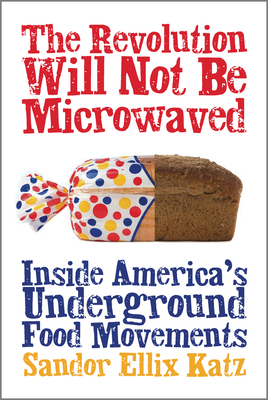
The Revolution Will Not Be Microwaved by Sandor Ellix Katz


I loved this book so much that the whole time I was reading it, I just wanted to find Mr. Katz and shake his hand. And then invite him over for dinner.

The bookstore had this book sitting on the shelf for about a year and no one had purchased it. Our book buyer wanted me to pull this lovely treasure from the shelf and return it to the publishers to make room for books that might sell better. I couldn't do it. Even though I had not yet read the book, I knew that with a title like this one, it had to be good. So I promised to read the book, write a review and attempt to hand-sell the crap out of it. And although my hand-selling skills are limited, I will certainly talk to anyone willing to listen about the reasons this book deserves a spot on the shelves.

This book mixes the some of the good bits of Pollan, Kingsolver, Bittman, even a bit of McKibben. The point is, you can pick up this book anywhere along your journey to food knowledge and activism. It can be a beginning, or it can be the next book in a long series of food system information. Katz touches on environmentalism, heath, the overcomplicated food system, and even throws in some recipes.

What's even better is that Katz doesn't stop short after bringing up all of the problems, he gives examples of what others are doing to solve these problems. He cites specific organizations and people who fight the system and how they are doing it. Each chapter has several pages of resources for more information on the problems and solutions. The bibliography alone is enough reason to buy this book. Getting through it will probably keep me occupied for years.

Buy it indie!

Tuesday, April 5, 2011

No Impact Man by Colin Beaven

I knew the moment I saw this book that I would love it. And I do. Beavan spends a lot of energy judging people and governments for the state of the environment, but does little to examine his own life, or even make the simplest changes. After watching Anne Leonard's video, The Story of Stuff, he realizes it's time to make a change. He devises a one year project called No Impact Man that will rid himself and his family of all possible environmental impact.

I'm a strong believer in doing all of it, or none of it, which made me really appreciate Beavan's amazing commitment. I found a lot to be inspire by in this book, even though I consider my own footprint to be fairly light. His complete refusal to create any waste really made me think about how much I waste, that I really don't need to.

The best thing about this book was that Beavan creates a more fulfilling life for himself and his family by simplifying. Instead of rushing around, they make more time for each other. Instead of take-out, they cook their own food and sit down with each other. Instead of taking a cab, they enjoy the city by waling or biking. Instead of watching TV, they play games. On top of the improvement in their health and quality of life, they saved a ton of money by not shopping, using no electricity, cutting out disposable products, making their own cleaners, and not paying train and cab fairs. Not to mention what they will probably save long-term for medical bills by taking better care of themselves.

Beavan doesn't just write about what he did, he writes about why he did it. He writes about what he got out of it. His reflections about our way of life are so simple and logical, yet we hardly ever stop and really think about the fact that we can change if we want to. He discovers that there is no reason for him to rush around when all he really wants to do is spend time with his family. There is no reason to order take out when he can make the time to cook. There is no reason to wrap his baby girl in toxic plastic diapers if they can take a few extra minutes to wash some fabric ones, which she prefers by the way.

The motivation behind every choice he makes is backed by statistics and very clear research. The facts he uses throughout the book really drive his point home. The need to get involved becomes emotional. It's not some far-off problem we'll deal with when it happens, it's something we have to address now. The fact that stuck with me most, which I have pondered every day since reading it, is this: 80% of everything manufactured on this planet today is created to be used only once. We live on a planet of finite resources. People all over the world die for oil, entire ecosystems are ruined for it, and we are throwing away 80% of everything we make with it after the first use? Why?!?!

It's no wonder his book inspired me to change my own habits. I'm not sure how anyone could read it and not be driven to change, even just a little.

Friday, April 16, 2010

That's Why We Don't Eat Animals by Ruby Roth

Kids ask so many freaking questions! I have found myself in so many awkward situations because I wasn't exactly sure of the most appropriate way to explain certain things to a child. My veganism is one of those tricky subjects. I think kids should know where food comes from and that some of it may have come from an animal, but I don't think it's ok to scare kids into vegetarianism, and it's inappropriate to step on another parent's toes. However, kids ask questions because they need to understand their world and the different kids of people that they share it with, vegans and meat-eaters alike.

This book is one great way to tackle that scary question, "What's a vegan?" It's a wonderful book about vegetarianism for kids. It's a very gentle and un-scary way to explain what vegetarianism is and why some people don't eat animals. The illustrations are very sweet, depicting happy animals in natural settings and sad animals in factory farms. I also have to say that, as an adult, I still enjoyed this book for myself and managed to learn a few things from it. Did you know that a heard of cows will all moo together until a missing member finds its way home? I didn't.

Now, don't even ask me where to begin when a kid wants to know where babies come from. Go ask your mother.

Tuesday, April 6, 2010

Book Review - Let the Great World Spin by Colum McCann

I've always been captivated by stories of New York in the 70's and 80's, back when it was still a dangerous and trashy city, when Times Square was all smut and crime, without the Disney musicals. Let the Great World Spin takes place in that era. It has all the dirt and grime, but it is a story about people, so it also has their hope. The stories move between the South Bronx, the Upper East Side and the Financial District (the southern tip of Manhattan).

The book takes the stories of many different people, from all parts of life, and weaves them together slowly and delicately. Most of them do not even know they are connected; they may sense it, but they will never fully understand it. An Irish priest and his brother, living in the South Bronx, one to find the underworld, the other trying to get out of it, become entangled in the lives of a group of prostitutes. A rich mother loses her only son in Vietnam and tries to find other mothers to connect with. A lost artist gets into a car accident that will change the course of all of their lives and set the story fully in motion.

The stories are all fictional, but they have something very important, and completely true, in common. In 1974 Phillipe Petit strung a wire between the Twin Towers and by walking across it he created an instant network of people, all connected by the same miraculous moment. Petit created one more piece of web to connect all of these stories. At the very height of their stories, the climactic turning point, they all experience the man dancing on the wire between the Twin Towers. His 140 foot length of cable, somehow crossed over the entire city at once, From the South Bronx, to the Upper East Side and back to the Financial District.

I loved this book. It's definitely a must-read for any fiction lovers.

Sunday, March 14, 2010

Book Review - Eaarth by Bill McKibbon

If it were up to me I'd make this book required reading for everyone on the planet. It's one of the most important books ever written about climate change. In fact, the only reason it's not the most important book, is because books written in the 70's and 80's predicting climate change were far more important, though mostly ignored. If we had only listened then, we would need a book like Eaarth now.

The book starts strong. It caught my attention quickly, citing specific examples of climate change and it's results on both massive and small scales. I thought the reason the United States didn't take much interest in climate change was because those hardest hit by changes in the weather lived in other parts of the world, but the truth is, we've been hit too. The major difference is that American people, supported by the US government, have the money to import food, crank up the AC and even pack up and move if we want. However, at the rate we're going, we're going to reach a point where all the money in the world won't be able to buy you food that just won't grow, or remove the pollution from your water, or save your life when a hurricane crashes into your town.

But the book isn't all doom and gloom. McKibben simply wants to make sure you're listening. He wants you to know that you're not saving your children or your grandchildren anymore, you're saving yourself. He wants you to you fully understand that the planet has been fundamentally changed and it's not ever going to change back. The most we can do is stop things from getting worse. It's a really hard piece of information to swallow.

The second part of the book is more hopeful. McKibben doesn't have all of the answers to survival, but the ideas he has are really good ones. His points are valid. I really liked his idea of communities providing for themselves and looking out for each other. Why buy your electricity from a power plant when you can generate it yourself? There's real security in being able to take care of yourself. When oil starts to dwindle and the prices skyrocket why not power your electric car and your house at the same time with solar and wind power from your own yard? His point is that we can't wait for big government to save us and provide for us, we have to show them what we want. With the world in the state is in right now, bigger is not going to be better. We have to scale down, start taking back the power to care for ourselves.

McKibbon isn't attacking the government. He praises large scale projects like highways and general infrastructure. This country grew and grew and because of that, American people enjoy a fairly high standard of living. It's time to stop growing though. It's time to adapt to the world we created. No book I've yet read makes that more abundantly clear than Eaarth.

It ends on a good note. The kind of ending that makes it easier to recommend this book. He uses Vermont as a model for sustainability, but he talks about larger-scale projects as well; things that are working. He also points out the importance of the internet. The internet, this crazy tool that can connect anyone, anywhere. For example, I'm writing this review while sitting on a bus to NYC. The wireless internet connects me to millions of people, the biggest forum ever known. Any idea I'll ever have can instantly be shared with he world. There is no need for us all to be isolated, we can figure out solutions and move forward as a group. I can instantly find information about powering my own home, growing my own food, and converting my car to run on veggie oil by just getting online. The limitless connections of the internet are a gift when most of us don't even know our own neighbors. It's a hope, in a world where hope fades more and more the longer we live the way we do.

I have more to say about this book, and a few excellent quotes and stories to share from it, however I did not bring the book with me on the bus. I'm going to save those bits and pieces for a few weeks from now, after the book is available to buy. Check back mid-April for more on this title!

And, in the interest of saving paper, I will gladly loan you my copy.

Friday, February 19, 2010

Wicked Plants - Amy Stewart

What a charming and interesting book. I had no idea that so many common plants were so freaking bad for me and might possibly be able to kill me or my cat (this is imagining that I have a cat of course). For instance, did you know that tulip bulbs can cause blisters on the hands of people who package them because they are slightly poisonous? I mean, I always knew that tulips could inspire murder and ruin economies, but blisters? Now that's crazy!

The book isn't all poison though. It also highlights plants that are destructive, and illegal, intoxicating, unpleasant, and dangerous. Apparently Stewart's opinion is that tobacco is the most dangerous plant of all. I'd have to say I agree with her on that one, though the Australian Stinging Tree sounds excruciating.

There were so many little tid bits about the plants I see every day or even keep in my house. The book isn't set up in a way that is meant to be shocking or scary; it's interesting and fun. The author includes fun little facts and stories about most of the plants, which makes it more fun to read. It's also such a nice size and comes with a ribbons attached to use as a book mark. Why don't all hardcover book come with ribbons damn it?

I had mixed feelings about the art in the book. The etchings, done by Briony Morrow-Cribbs, were very well done and interesting. They were beautiful and eerie at the same time, very much in the spirit of the book as a whole. They also remind me of the art my friend Lisa does, which helps. However, the little illustrations, done by Jonathon Rosen, were so poor that they actually annoyed me. They look like hasty doodles. I actually checked out his website because his bio in the book had some impressive commissions. His work varies from the doodly things seen in this book, to some impressive illustrations for newspapers and magazines. Go figure.

Basically, when I was done reading this book, I wished there was a poison garden somewhere around here to visit. I have such a new appreciation for the scary power of the plant world. I always knew dangerous plants existed, but I guess I didn't realize just how common they were, and just how dangerous they could be.

Monday, February 1, 2010

Book Review - Generation A by Douglas Coupland

Douglas Coupland's writing is a little Chuck Palahniuk, without trying as hard to be clever, and a little Kurt Vonnegut, though not so cynical. This book is not his first novel, but it almost reads like one. It doesn't make me interested to read his other books anytime soon, which is a bummer because I had high hopes for this book.

The story is about the foreseeable future when bees have gone extinct. No one has seen them for at least five years. Suddenly 5 different and seemingly unrelated people get stung. The book is told from their individual perspectives. Coupland does a good job of giving them all different personalities, though the writing style for each voice is basically identical. I found myself having trouble believing that the perceptive introvert was perceptive at all in certain chapters. At times he told his story like an ignorant fool.

I had bigger problem with the pacing. The story was all beginning and end, with no middle to speak of. We start out with the 5 people getting stung and they are whisked away to underground labs to be studied for a month, without explanation as to why. Then they go home, but before anything can happen there, they are whisked away yet again to a remote island where they find out why they were stung and what the results of being locked away underground were. Why even have them go home at all? Coupland seemed to be in a rush, but nothing gets me into a book like a writer who savors the story.

But I don't want to be misleading, it's a fun book and Coupland has a smart writing style. It was an easy read and an enjoyable one. It simply wasn't my favorite and I won't be rushing to re-read this book. I still stand by it being an interesting story idea, I just wish there could have been more to it. In a way that's a compliment. It's not like I didn't finish the book; I liked it enough to want more from it.

Monday, January 18, 2010

Book Review - Vegan Freak by Bob and Jenna Torres

This book is a must have for any vegans, vegetarians, or people somewhere in between. It's kind of a how-to guide to surviving in a very non-vegan world, where you will probably be looked at as a freak.

It deals with the obvious question of "why vegan?" and also the less obvious question of "why vegan and NOT vegetarian?" It also deals with the parts of veganism that involve non-food items. I especially like the chapters about how to handle non-vegans, specifically family and friends.

I really identify with and needed something like this book. It explains the importance of having vegans friends and a vegan community. I live in a small town and I'm lucky to know even one other vegan. I spend a lot of time reading vegan blogs and I communicate with my vegan friends in NY whenever I feel like I need a vegan ally. Part of the reason I have this blog is for and outlet for my life and my veganism is part of that. It's frustrating to feel like you're the only person around who sees the very serious cruelty involved in the non-vegan ways of the people around us, especially the people we love.

The only major criticism I have about this book is the editing. In this case, it seems like the major part of the editing process was done by a spell checker and not much more. I found so many major grammatical errors in this book it drove me mad. Simply sending the book to anyone else and having them read it cover to cover would have solved so many of the editing issues. Oh my god I have never read a book with so many typos. Even my college papers had less problems than this book. Bob and Jenna, if you're reading this, I adore you guys, but please fix this stuff before the next printing. (For all you people out there who would argue that my own blog is full of errors, I'll remind you that I openly admit to not proofreading mot of this, it's not a published book, and I make absolutely no money from it. It's a hobby, not a job and is in no way professional.)

I don't want to make the book sound amateur, it's not. It's so clear that a lot of thought and research went into it. They include many other books to refer to for more information and help on any of the many topics they touch on in the book. It's a starting point, and an important one. So, if you're vegan, or thinking about it: go buy this book! Or borrow it, whatever.

Monday, January 11, 2010

Book Review - The Count of Monte Cristo by Alexandre Dumas

I can't review this book. How could I review this book? I feel like a fraud. What right do I have to write anything about this amazing story? It's a classic for a reason! It's so perfect and meticulous. Dumas created the most amazing and perfect characters and had no trouble whatsoever bringing them to life. There's not a speck of laziness in his writing. He takes no shortcuts, creates no miracles without explanation, and he runs the reader through every possible emotion throughout the story.

Edmond Dantes is wonderful. He's an honest and good person and he's perfect in so many ways. If he's slightly conceited, it is only because he is too young to know any better. When he becomes the Count of Monte Cristo he is conceited because he has learned to know better. He is the ultimate instrument of revenge and wrath. He is so perfect and adept at his revenge that at times it gets away from him, it takes on it's own life. He forgets that he is human and I found myself forgetting as well. However, Dumas reminds his readers before he reminds The Count. We see what is about to unfold just before Dantes and just after it is too late to stop any of it. The revenge is so perfectly plotted, no detail is left out. However, it is impossible to know the full extent of it, only because it impossible to know any person to the fullest extent. Who knows just how far any one character will go? No one but Dumas it seems.

The ending. Oh the ending. Of course I would never reveal the ending. But, oh is it perfect. Amazing. A believable fantasy, just like the rest of the book, but somehow even more so. And just like the rest of the book it is impossible to say just what happens after the last page. The story will never rest, because, like life, there are no tidy endings. Like life, you can never really know what path people will choose, or what tomorrow will bring.

Sunday, January 3, 2010

Book Review - Sleeping Naked is Green by Vanessa Farquharson

Vanessa Farquharson is a movie critic for the Canadian newspaper National Post and doesn't care too much about the environment, until she sees "An Inconvenient Truth," and finally feels that she needs to do something. But what? She decides to take on a challenge of making one green change in her life every day for a year.

The book is divided into chapters by month and each month starts with a list of the changes she made each day. It starts out simply: Changing to recycled paper towels. But she soon starts to become desperate and shuts off her freezer, then her fridge. The order in which she makes her changes is... well, odd to say the least. For example, she turns off her fridge before putting a brick into her toilet tank. She gives up toilet paper before she gives up her vacuum. She also waits until day 198 to sign up for CSA.

She soon finds that being just a little green suddenly makes her want to be as green as possible. She wants to be the greenest in the green movement and often finds herself jealous and competitive of other environmentalists. At the same time she struggles with frustration over making certain changes and exhaustion from having to think new ones up. Some might be seen as a cop-out (writing only haiku poetry, signing up and then promptly taking down her profile on greensingles.com) but you have to give her credit and cut her some slack, she's making 366 (leap year) changes.


She whines endlessly about how hard it is to be an environmentalist, but when it comes time for her challenge to end, she keeps almost all of her green changes. This book is just further proof that anyone who is educated about the changes they can make and why they should make them (not to mention how easy it can often be), will make them. And they will start to care about it too. It's easy to claim ignorance about the environment and do nothing, but once you do know, it's harder to forget. She even manages to green her family a little, even though they were adamantly against environmentalism at the start.

This book is inspiring. And funny. And down to earth. Plus it's a great read. It's good information for environmentalists or just people curious at where to start. The green movement is often seen as either too extreme or just not enough, but Farquharson struggles to find a middle ground. Reading this book made it more apparent to me just how easy it could be to step up my own greening. It's nice to see all of her changes in a list in each chapter, because although she doesn't talk about each one, you still know what kinds of changes she is making.

Because Farquharson is a journalist, her writing is interesting and engaging. She talks about the changes and why she made them, but also what the result is on her life as a a whole. Not to mention she's hilarious. The book isn't just a list of changes that you can make, it's a story about making a difference. At the end Farquharson isn't a preachy environmentalist. She sticks with her own changes, because she sees no point in going back. But there's no denying that the story is an inspiration to those who read it. It's a story about how little changes can make a big difference, not just to the Earth, but to your entire life.

Saturday, December 26, 2009

Book Review - Eating Animals by Jonathan Safran Foer

Eating Animals is kind of a 'tough love' sort of a book. It's not a lecture and it's not a rant. It's different than most books about vegetarianism. Foer wants to put the facts out there and let you make the decision. He writes this book under the assumption that once people have all of the information, they'll make the choice that's right for them. And I agree. There are people out there who will never care about animal cruelty, or will care, but still tell themselves there is nothing they can do. Those people are a lost cause and the book wasn't written for them. It was written for people who do have enough will power to make changes in their lives. This book is for people who know that the choices they make affect everyone around them.

Foer started to think about vegetarianism (and this book) when he started to think about being a father. Like so many people he had wanted to be a vegetarian for years and had struggled with it his whole life. He knew it was the right thing to do, but still couldn't manage to do it. He cared about animals, but he also cared about eating whatever tasted good to him. When he realized he was to become a father, his food choices suddenly started to matter. He was to set an example for his son. He was going to be a role model and he wanted to be a good one.

Foer tries very hard to get all angles of the argument. He gets letters from activists of all kinds, factory farmers, family farmers, a vegan who designs slaughter houses, a vegetarian who raises beef cattle. Of course these contradictions annoy me, but they also make me really think about what the goal is. Is the goal to stop animal cruelty, or stop animal slavery? Is the goal to cause less suffering, or no suffering? At the end of the day do these people feel good about the choices they have made? Do they think they are making a difference? Do they really feel happy about the lives they are leading? If they do, maybe they are doing more good than harm. Maybe they are on the best path they can be on. Of course to me, and to Foer, any harm at all is enough reason not to eat meat (most of these family farmers still brand their cattle, and all of them send their animals to slaughter houses. None of these animals ever grow to full adulthood).

My favorite part of this book was the chapter of definitions. Several pages with common animal farming terms put into plain (and sometimes hilarious) English. Even though I read heavily on the subject of food, there are so many things in this book I had never heard before, so many good points that had yet to be made. Are you aware that cattle are often fed ground up cats and dogs that are euthanized at shelters? That pigs become so distressed in their living conditions that even a tractor driving by outside (they are kept inside for their whole lives) can cause them to fall over and die of fright?

He ends the book with Thanksgiving. To have a turkey, or not to have a turkey? He talks about tradition, culture, family history, values. He talks about the origins of thanksgiving and the history of the turkey as a center piece. He points out that the turkey doesn't make Thanksgiving. It's the coming together, the family, the thankfulness. The truth is, having a dead, mutated, genetically altered, abused carcass as the center to a holiday about charity is a gross contradiction and he sees that. The turkey doesn't make his holiday table.

My only criticism of this book is this: like Micheal Pollan (who he chastises for doing just this), Foer doesn't address his own contradictions. Not once does he mention the dairy industry. Not once. He talks a bit about laying hens, but not enough to actually point out that eating chicken eggs is just as bad as eating chicken meat (if not worse because at least boiler hens are not kept in battery cages). He lets himself completely off the hook. The entire book is dedicated to the problems with factory farming, but that's where more of our dairy comes from, and almost all of our eggs. If he finds issues even with the family farms in his book (which he does), than how does he explain his consumption of dairy and eggs? I kept waiting for him to address this, but it never comes up.

So yes, I loved this book. I think it's a wonderful starting point. A well written starting point. But it is just a start. I wanted it to go further.